

Utility Connections in the East of England
Air Utilities delivers electricity, gas and water connections across the East of England, covering Cambridgeshire, Norfolk, Suffolk, Essex, Hertfordshire and Bedfordshire. We work with UK Power Networks, Cadent and Anglian Water as a NERS, GIRS and WIRS accredited Independent Connection Provider. This region has a constraint that most do not, and it is not electricity. The entire Anglian Water region is classified as an area of serious water stress, and in parts of Cambridgeshire that has already stopped developments proceeding. Understanding where that applies to your scheme is not a detail here. It is the first question.
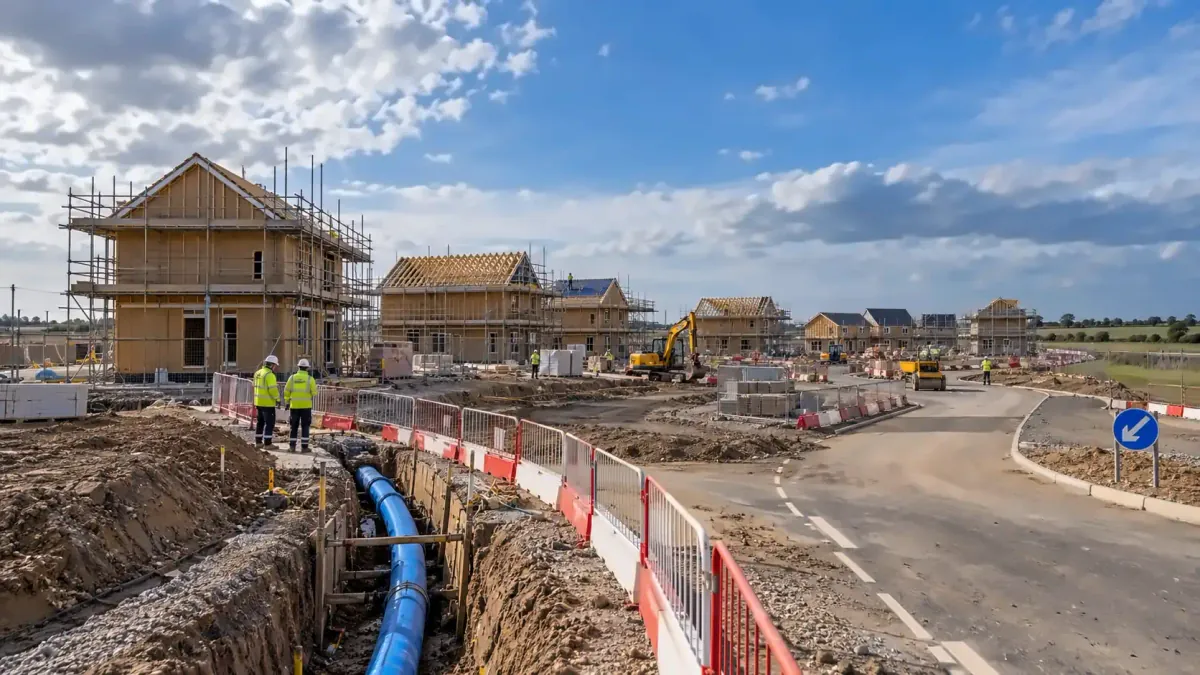
The East of England Is Growing Faster Than Its Water Supply
This region contains some of the fastest growing cities in the country, with Cambridge and Peterborough among them, and hundreds of thousands of additional residents expected over the next two decades.
It is also the driest part of the country, and the water position has moved from background concern to an active planning constraint.
The development mix here is broad. Cambridge and the surrounding corridor carry intense life sciences, research and residential growth. Peterborough, Norwich, Ipswich and Chelmsford produce steady commercial and housing development. The Norfolk and Suffolk coastline has become one of the UK’s most important offshore wind landing zones, bringing substantial onshore cable and substation infrastructure with it. And a great deal of the region is rural, where the nearest usable point of connection may sit some distance from the site.
We deliver across all of it, individually or as a coordinated multi utility package.
Electricity, UK Power Networks
UK Power Networks is the Distribution Network Operator for Eastern England, one of its three licence areas alongside London and the South East.
One piece of regional context worth having: the East of England is already a net export region for electricity, and the growth in generation capacity connecting here, driven overwhelmingly by offshore wind landing on the Norfolk and Suffolk coast, substantially exceeds the growth in local demand. The region has around 3.7GW of offshore wind already operational with roughly a further 10GW in the pipeline.
For a typical development that changes very little day to day. What it does mean is significant onshore transmission and cable corridor work crossing the region, which is relevant if your site sits anywhere near one of those routes, and it means the network here is under active development rather than static.
Gas, Cadent
Cadent operates the gas distribution network across the East of England, as one of its four network regions. New gas mains and service connections are designed to Cadent’s adoptable standards, and the contestable construction can be carried out by an accredited provider such as ourselves rather than going direct to Cadent and accepting a fixed price with no competition on it.
Water, Anglian Water, and two others
Anglian Water is the principal water and wastewater company across the region, covering the largest geographic area of any water company in England and Wales.
Two others operate here as well. Essex and Suffolk Water supplies parts of Essex and Suffolk, and Cambridge Water supplies the Cambridge area. On sites near those boundaries, confirming which company actually covers the address before applying prevents a wasted application.
As a WIRS accredited self lay provider we lay new water mains and make service connections ourselves, which brings the lower published connection charge into play and lets water share a trench with your other utilities.
Water Scarcity: The Constraint That Defines This Region
If you are developing in the East of England, this is the section that matters most.
The whole of the Anglian Water region is formally classified as an area of serious water stress. That is not campaigning language; it is the designation used in government policy and in Anglian Water’s own planning documents.
The consequences have been concrete. In Cambridgeshire, water stress has already delayed around 9,000 homes and 300,000 square metres of commercial development. The Environment Agency withdrew its support for already approved development plans covering those 9,000 homes and a cancer hospital, pausing construction and lodging an objection on the basis that there was not enough water.
The scale of the wider risk has been set out in Parliament: more than 60,000 homes could become undeliverable across this Parliament due to water constraints, representing more than £25 billion in lost value, with research suggesting that in some areas nearly 40 percent of the Government’s new housing target cannot be delivered under current water supply conditions.
There is a second constraint alongside it that receives less attention. Anglian Water has objected to commercial developments on the basis that it cannot manage the sewage those developments would produce. Wastewater capacity is a separate bottleneck from water supply, and on some sites it is the binding one.
What is being done. A Cambridge Water Scarcity Group has been convened, bringing together the agencies and water companies. A new Fens Reservoir, a joint venture between Anglian Water and Cambridge Water costing in the region of £2 billion, is planned, but it will not be operational until the mid to late 2030s. In the interim, water transfers from Grafham Water are being relied on. Water efficiency standards for new homes in seriously water stressed areas are being pushed towards 100 litres per person per day.
One procedural detail every developer here should know. Anglian Water is not a statutory consultee in the planning process, despite being obliged to accommodate developments that hold automatic rights to connect to its network. In practice that means water capacity can be absent from the planning conversation until well after permission is granted, at which point it becomes your problem rather than a planning condition.
What this means for your scheme. Raise water availability and wastewater capacity as early as you raise electricity. On a Cambridgeshire scheme in particular, treat it as a feasibility question rather than a delivery detail, because it has already stopped projects that had everything else in place.
Our Services in the East of England
Delivered individually or as a coordinated multi utility package.
- Water connections and self lay, under WIRS, including early feasibility on availability
- Electricity connections, LV and HV, including substations, under NERS
- Gas connections, new mains, service pipes and meters, under GIRS
- Multi utility packages, all three utilities in one contract and one trench
- NAV adoption arrangements, where an alternative water provider suits the scheme
- EV charging infrastructure, with the power supply designed as part of the same package
- Utility diversions and disconnections, including Section 278 coordination
- Temporary builders supply, so your site has power from day one
Why Developers in the East of England Work With Us
- We take water seriously here, because the region requires it. On most schemes in most regions, water is the straightforward one. In this region it is frequently the constraint that decides whether a scheme proceeds. We raise it at feasibility rather than treating it as a late stage detail.
- WIRS accredited self lay. We lay the mains and service connections ourselves, which brings the lower published connection charge into play and gives us direct visibility of the water process rather than waiting on a third party.
- Accredited across all three schemes. NERS, GIRS and WIRS, administered independently by Lloyd’s Register. Few providers hold all three.
- More than 1,000 connections delivered. Across England, for contractors, developers and homeowners.
- One point of contact. UK Power Networks, Cadent and Anglian Water, managed by us.
Areas We Cover in the East of England
- Cambridgeshire
Cambridge, Peterborough, Huntingdon, St Neots, Ely, Wisbech
- Norfolk
Norwich, King's Lynn, Great Yarmouth, Thetford, Dereham
- Suffolk
Ipswich, Bury St Edmunds, Lowestoft, Felixstowe, Haverhill
- Essex
Chelmsford, Colchester, Basildon, Southend on Sea, Harlow, Brentwood
- Hertfordshire
Watford, Stevenage, St Albans, Hemel Hempstead, Welwyn Garden City
- Bedfordshire
Luton, Bedford, Dunstable
Frequently Asked Questions
Which electricity network covers the East of England?
UK Power Networks is the Distribution Network Operator for Eastern England, one of its three licence areas. The region is a net exporter of electricity, with substantial offshore wind capacity connecting along the Norfolk and Suffolk coast.
Which gas network covers the East of England?
Cadent operates the gas distribution network across the East of England, as one of its four network regions. Contestable connection works can be carried out by an accredited GIRS provider rather than going direct to Cadent.
Which water company serves the East of England?
Anglian Water is the principal water and wastewater company across the region, covering the largest geographic area of any water company in England and Wales. Essex and Suffolk Water covers parts of Essex and Suffolk, and Cambridge Water covers the Cambridge area.
Is water scarcity really a problem for development here?
Yes. The whole Anglian Water region is classified as an area of serious water stress. In Cambridgeshire, water constraints have already delayed around 9,000 homes and 300,000 square metres of commercial development, and the Environment Agency has objected to approved development plans on water availability grounds. Wastewater capacity is a separate constraint, with Anglian Water having objected to commercial schemes on sewage capacity grounds.
When will the water position improve?
A new Fens Reservoir, a joint venture between Anglian Water and Cambridge Water at a cost of around £2 billion, is planned but will not be operational until the mid to late 2030s. Interim measures include water transfers from Grafham Water and tighter water efficiency standards for new homes.
How long does a utility connection take in the East of England?
As a general guide, a straightforward connection runs somewhere between 8 and 20 weeks from application to energisation. In this region the variable that most often extends that is water availability rather than electricity capacity, which is why it is worth raising at feasibility.
Get a Free Quote for Your East of England Project
Tell us about your site anywhere from Cambridge and Peterborough to the Norfolk and Suffolk coast, and we will confirm what your connection needs, including an early read on the water position. Accredited across electricity, gas and water.