

Utility Connections in London
Air Utilities delivers electricity, gas and water connections across Greater London, working with UK Power Networks, SSEN, Cadent, SGN and Thames Water as a NERS, GIRS and WIRS accredited Independent Connection Provider. London is the most operationally complex connection market in the country: dense buried infrastructure, multiple network operators across a single city, highway consents on almost every scheme, and in parts of West London, genuine capacity constraints that have delayed developments for years. Knowing where those pressure points are before you design around them is most of the job.
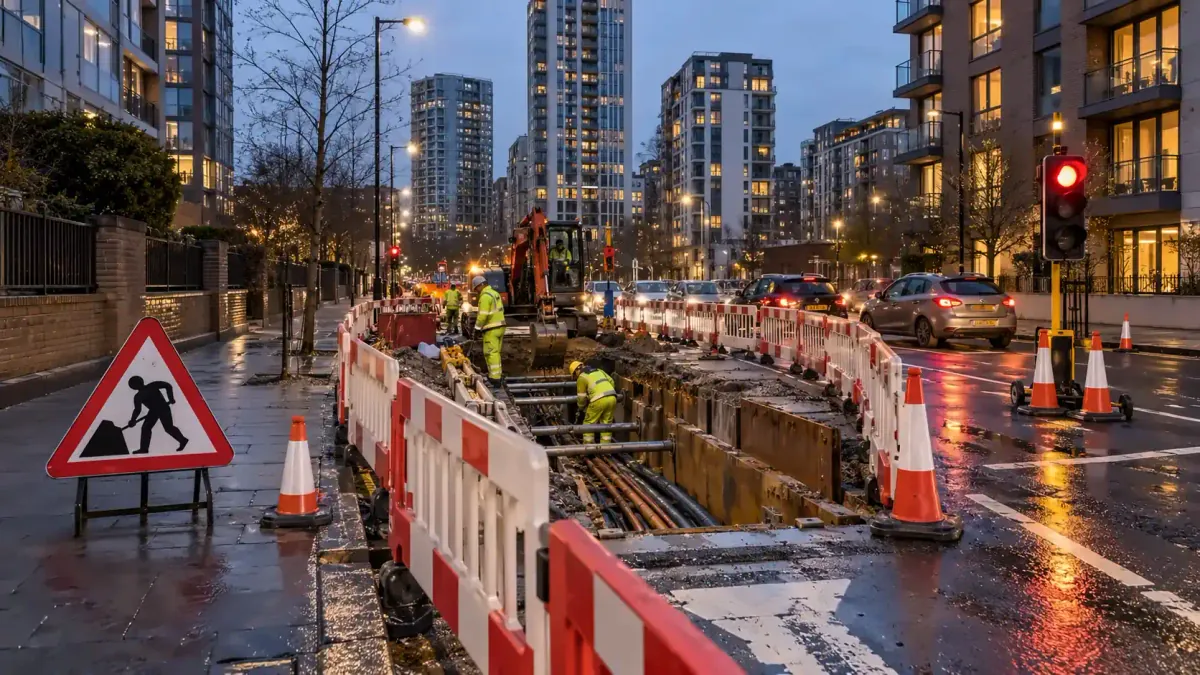
Why London Is Different
Other regions have one electricity operator, one gas network and one water company. London has more, and the boundaries do not follow the borough map.
On top of that, the ground under London is genuinely congested. Utility records are less reliable here than almost anywhere else, because the infrastructure is older and has been altered more often. Almost any connection touching a road requires highway authority consent and traffic management, and in central boroughs those consents are neither quick nor cheap.
And in one part of the city, capacity itself has been the binding constraint on whether homes could be built at all.
Electricity, UK Power Networks and SSEN
UK Power Networks is the Distribution Network Operator across most of Greater London, and is the operator you will be dealing with on the large majority of London schemes.
But West London is not UKPN. Scottish and Southern Electricity Networks, SSEN, owns and operates the distribution network covering the West London boroughs, including Hillingdon, Ealing and Hounslow. This is one of the most consequential facts on this page, because it is both easy to get wrong and, as set out below, the area where capacity problems have been most severe.
Confirming which of the two operators actually covers your site, before any application goes anywhere, is a five minute check that has cost other people months.
Gas, Cadent in the north and SGN in the south
London’s gas network splits geographically between two operators.
Cadent covers North London, as one of its four network regions. SGN, sometimes referred to as Scotia Gas Networks, covers South London alongside the rest of southern England.
Both allow developers to use independent GIRS accredited contractors for the contestable connection works rather than going direct to the network operator. Going direct means accepting a fixed price with no competition on it. On a London scheme, where civils and traffic management costs are high, that competitive element is worth more than it would be elsewhere.
Water, Thames Water
Thames Water is the water and wastewater company for London and the Thames Valley, serving around 15 million customers, making it the largest water company in the UK.
Parts of Greater London sit with other suppliers. SES Water covers areas of South London and Surrey, and Essex and Suffolk Water covers parts of the north eastern fringe. On sites near those boundaries it is worth confirming the actual supplier for the address rather than assuming Thames.
As a WIRS accredited self lay provider we lay the new mains and service connections ourselves, which brings the lower published connection charge into play and lets water share a trench with your other utilities, which matters considerably in a city where opening the ground is expensive.
West London Capacity Constraints: What Actually Happened
This is the single most important piece of context for anyone developing in West London, and it is worth setting out properly rather than in a sentence.
From around 2022, a rapid influx of data centre connection requests hit the West London network. Data centre operators were seeking to co locate alongside the fibre optic cables running through the region along the M4 corridor and out across the Atlantic. Data centres consume electricity at the scale of towns or small cities, and the volume of those requests absorbed the remaining capacity in SSEN’s West London region, on the Greater London Authority’s own assessment, for the remainder of the decade.
In July 2022 the GLA wrote to developers confirming that the electricity network in Hillingdon, Ealing and Hounslow was severely constrained. By November 2022, nineteen developments representing around 5,300 homes were waiting on a confirmed connection.
The response has been substantial. The GLA worked with SSEN, National Grid Electricity Transmission, the system operator and Ofgem on a series of short, medium and long term fixes. The most practical of these has been a ramped connection mechanism, under which developments requiring under 1MVA of network capacity per year can proceed, assuming no additional distribution level constraints apply locally. Around 10.5 MVA of demand capacity has been released this way, unblocking roughly 7,800 homes, of which around 2,900 are affordable. The threshold is being raised to allow larger developments to proceed on the same basis.
By early 2025 these efforts had enabled electricity connections for over 12,000 new homes across the affected boroughs.
The honest position today: real progress has been made, but the constraint has not disappeared. GLA reporting indicates that while around 12,600 homes in the affected boroughs have a connection secured, roughly 3,900 homes that are on site or hold planning permission still do not.
What this means for you. If your site is in Hillingdon, Ealing or Hounslow, capacity is a live design constraint rather than a background detail. Phasing your demand, understanding whether the ramped mechanism applies to your scheme, and getting a point of connection enquiry in early are not optional refinements. They are the difference between a deliverable programme and a stalled one.
Two Things Worth Knowing in London
The Mayor’s Infrastructure Coordination Service. The GLA operates a Development Coordination Service in partnership with London boroughs, with dedicated Infrastructure Coordinators working to help developers navigate connection processes and reduce disruption. It has been running in boroughs including Tower Hamlets, Westminster, Croydon, Lambeth and Redbridge. If your scheme sits in one of those, it is a resource worth using.
The Common Ask Template. UK Power Networks, Cadent and SGN have jointly introduced a simplified process letting local authorities provide connection information once, in a single standardised format, rather than repeating it separately to each network. It was designed with EV charging and low carbon heating projects in mind, and it is a useful signal that the three London networks are now coordinating more closely than they once did.
Our Services in London
Delivered individually or as a coordinated multi utility package.
- Electricity connections, LV and HV, including substations, under NERS
- Gas connections, new mains, service pipes and meters, under GIRS
- Water connections and self lay, under WIRS
- Multi utility packages, all three utilities in one contract and one trench
- EV charging infrastructure, with the power supply designed as part of the same package
- Utility diversions, including Section 278 highway coordination
- Utility disconnections for demolition and redevelopment
- Temporary builders supply, so your site has power from day one
Why Developers in London Work With Us
- We know where the boundaries are. UKPN and SSEN. Cadent and SGN. Thames, SES and Essex and Suffolk. Four of those five splits catch people out, and applying to the wrong operator is a straightforward way to lose weeks.
- We understand the capacity position. Particularly in West London, where whether a scheme is deliverable can depend on how its demand is phased.
- Accredited across all three schemes. NERS, GIRS and WIRS, administered independently by Lloyd’s Register. Few providers hold all three.
- Section 278 coordination as standard. Almost every London connection touches highway land. We run the highway authority process alongside the network operator process rather than in sequence.
- One point of contact. Five network operators and a highway authority, managed by us, on your behalf.
Areas We Cover in London
- Central
Westminster, Camden, Islington, City of London, Southwark, Lambeth, Tower Hamlets
- North
Barnet, Enfield, Haringey, Brent, Harrow
- East
Newham, Hackney, Redbridge, Barking and Dagenham, Havering, Waltham Forest
- South
Croydon, Bromley, Lewisham, Greenwich, Wandsworth, Merton, Sutton, Kingston, Richmond
- West
Ealing, Hounslow, Hillingdon, Hammersmith and Fulham, Kensington and Chelsea
Frequently Asked Questions
Which electricity network covers London?
UK Power Networks is the Distribution Network Operator across most of Greater London. However, the West London boroughs including Hillingdon, Ealing and Hounslow are covered by SSEN rather than UKPN. Confirming which operator covers your specific site before applying is essential.
Which gas network covers London?
London splits between two gas networks. Cadent covers North London and SGN covers South London. Both permit developers to use independent GIRS accredited contractors for the contestable works rather than going direct to the network operator.
Which water company serves London?
Thames Water is the water and wastewater company for London and the Thames Valley, serving around 15 million customers. Parts of Greater London are served by SES Water and Essex and Suffolk Water, so on sites near those boundaries it is worth confirming the supplier for the address.
Is there still an electricity capacity problem in West London?
Partly. Constraints in Hillingdon, Ealing and Hounslow, driven largely by data centre demand along the M4 corridor, delayed thousands of homes from 2022 onwards. A ramped connection mechanism and other measures have since enabled connections for over 12,000 homes, but GLA reporting indicates several thousand homes on site or with planning permission still lack a secured connection.
Do I have to use UK Power Networks for my connection?
No. UK Power Networks permits developers and contractors to appoint NERS accredited ICPs and IDNOs to carry out new connection works in place of UKPN itself. Those providers compete on the open market, which frequently delivers better pricing than the network operator’s own rate. The non contestable works remain with the network operator.
How long does a utility connection take in London?
As a general guide, a straightforward connection runs somewhere between 8 and 20 weeks from application to energisation. London commonly runs longer because of highway consents, traffic management and dense existing infrastructure, and considerably longer in areas where network capacity is constrained.
Get a Free Quote for Your London Project
Tell us where your site is and we will confirm which operators actually cover it, whether capacity is a constraint, and what your connection will take to deliver. Accredited across electricity, gas and water, with Section 278 coordination handled.